









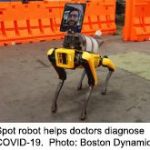
Bright yellow and looking like a headless deer, Spot can travel across ground too risky for humans. “Built for dirt and danger,” in the words of its maker Boston Dynamics, this robot is now helping humans battle a different threat: the spread of coronavirus. Equipped with an iPad and two-way radio, Spot has been making the rounds at Brigham and Women’s Hospital in Boston since April. Medical technicians use the robot to interview patients with suspected COVID-19 remotely, with no need to don personal protective equipment. Think of it as mobile telemedicine. Then there’s computer programs that pore through mountains of information to pluck out and analyze the relevant bits to help find a promising drug for COVID-19 after just two days’ work. Artificial intelligence (AI) tools are tackling the pandemic on every front: Robots that blast surfaces with high-power ultraviolet light are decontaminating hospitals around the world. Robots also stepped in to help Chinese hospitals cope with coronavirus, checking visitors’ temperatures, delivering food and medicine, keeping isolated wards clean and even offering a little entertainment. Medical robots can go where human doctors can’t, and process information much faster. But scientists are still only in the very early stages of using AI to treat patients. “There’s still a big gap between this kind of research and the clinical applications,” said Steve Jiang, a professor at… read on >