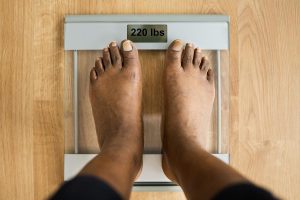







Are you hungry after you exercise? That might not be a problem if you’re at a healthy weight, but if you’re trying to shed extra pounds, the calories you take in could replace the ones you just worked so hard to burn off. For decades, researchers have tried to find out whether the intensity and/or duration of exercise could play a role in limiting hunger immediately and in the hours afterwards. Some, but not all, studies found that very high-intensity interval training (or HIIT) can cut your appetite. HIIT typically involves alternating 30 or 60 seconds of all-out effort with one to two minutes of rest, a pattern that you repeat for the 20 to 30 minutes of a workout. Other research found that longer workouts, up to 90 minutes, are effective at dampening hunger. Another plus: A study review found that if you want to burn fat, the longer your exercise session, the more you’ll burn. Problem is, many people aren’t able to work such long workouts into most days. Adding another wrinkle is that men and women seem to have different responses to exercise, making it impossible to suggest any one-routine-fits-all generalization. The answer? Try out different exercise timing and duration options to see which one has the best hunger-cutting effect on you. You might even find that exercise on an empty stomach…  read on >
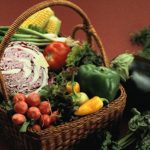
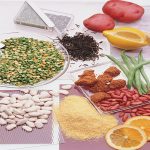
Many Americans still don’t get enough fruits, vegetables and other healthy foods. If money and time are concerns, your favorite drive-through donut and coffee place in the morning and the closest fast-food chain for dinner might seem to better fit your schedule and budget, even if you know these foods aren’t nutritious. You may feel it’s just too hard to get the suggested five or more servings of fruits and veggies every day, and maybe you’ve even given up trying. In either case, results of a large global study should encourage you to reboot your efforts to eat healthier. The study examined eating patterns of people across 18 countries and how fruits, vegetables and legumes (beans, dried peas and lentils) affected mortality and heart health. Results confirmed that eating these healthy foods lowers the risk for heart disease, heart attacks and early death. They also showed you can get such benefits with just three or four daily servings. Now, this isn’t to say that you should cut back if you’re getting more, but people who are getting little to none can aim to meet this more modest goal. The studies offered other surprising findings. One is that eating more fruits, seeds and beans can be as good for you as eating more vegetables — that’s good news for those who just can’t wrap their taste…  read on >

(HealthDay News) — Many alternative milk products are available on supermarket shelves, including milks made from soy, rice, almond, coconut and oats. These products may not have the same nutritional value as dairy milk, says the Dairy Council of California. Alternative milk products may be low in calcium and protein. For children, athletes and seniors looking to up their calcium and protein levels, soy ranks highest among alternative milks, the council says.

Want to reduce your risk of dementia? Take care of your heart. That’s the takeaway from a new study that suggests good heart health in middle age could lower your odds for problems with thinking and memory later in life. The study included nearly 7,900 British adults who did not have heart disease or dementia at age 50. Over an average 25-year followup, 347 cases of dementia were diagnosed among participants. Average age at diagnosis: 75. After taking other factors into account, researchers linked a higher score at age 50 on seven healthy habits outlined in the American Heart Association’s “Life Simple 7” with a lower risk of dementia later in life. The Life Simple 7 assesses smoking, diet, physical activity, fasting blood sugar, blood cholesterol, blood pressure and body mass index (a measure of body fat based on height and weight). Dementia rates were 1.3 per 1,000 person years among participants who had high scores on heart healthy habits, compared to 3.2 per 1,000 for low-scorers, according to the study published Aug. 7 in the BMJ. A better score at age 50 was also associated with higher overall brain and gray matter volumes in MRI scans 20 years later. Though the study could not prove that heart-healthy living actually caused dementia risk to drop, the researchers said their findings support public policies to improve…  read on >

Although colonoscopy screens for cancer, it can also uncover a common condition called diverticulosis. This is when one or more pockets develop in the colon wall, often in the large bowel. These pockets occur over time, possibly from not getting enough fiber in your diet or eating too much red meat. They’re so common that about 50% of people have them by age 50, according to the American Gastroenterological Association. Problems can occur if a pocket gets infected, swollen and inflamed, which happens to about 5% of people with diverticulosis. This condition is called diverticulitis. “Attacks” of it can come with pain in the lower left abdomen, fever, chills and changes in stool. You may also experience nausea and vomiting. Treatment for diverticulitis often centers on a short-term low-fiber diet to quiet the digestive tract, and possibly antibiotics to get rid of the infection. Some people get repeated attacks. There’s also the possibility of developing a serious abscess in a pocket and needing surgery to remove the affected section of intestine if the damage is severe. But you can take steps to lower the risk for repeated attacks and complications. After — and only after — the infection clears, slowly reintroduce fiber to your diet by eating more whole grains; legumes including beans and lentils; vegetables; berries; fruits with edible skins; nuts and even popcorn.…  read on >

Family meals are a recipe for healthy eating in kids, nutritionists say. “Research shows that families who regularly dine together are more likely to eat more fruits, vegetables and fiber and are less likely to eat fried foods,” said Kristen Gradney, a dietitian nutritionist and spokeswoman for the Academy of Nutrition and Dietetics. “Eating together promotes healthy weight in children, perhaps due to more nourishing food choices, and can encourage them to try new foods,” she explained in an academy news release. Plus, families who eat together tend to be closer, because mealtime encourages conversations. It helps kids feel more at ease sharing their feelings, which, in turn, can help lessen behavioral problems and may even improve their grades, Gradney said. As part of Kids Eat Right Month in August, the academy offers this advice to help parents make and enjoy family meals after a busy day: Choose meals without a lot of ingredients. Work with your children to create a collection of go-to recipes that can be ready in less than 30 minutes. Stock up on ingredients that can be used for more than one meal. For example, grill twice as many chicken breasts as needed for one dinner and use the extras to make fajitas the next night. Try to avoid take-out food. Though convenient, it’s not as healthy as a simple, homemade…  read on >

Taking your blood pressure may become as easy as taking a video selfie if a new smartphone app proves itself. High blood pressure can be a warning sign of a heart attack or stroke, but half of those with hypertension don’t know it. Developing an easy at-home blood pressure screen could potentially save lives. A new technology called transdermal optical imaging gives a picture of the blood flow in your face, which reveals your blood pressure, researchers say. “We found, using a smartphone, we can accurately measure blood pressure within 30 seconds,” said lead researcher Kang Lee. Lee is research chair of developmental neuroscience at the University of Toronto. “We want to use this technology to help us to make people aware of their blood pressure and monitor it,” he said. Lee doesn’t intend this technology to replace standard “cuff” blood pressure measuring, but rather to make blood pressure easy to take at home. So how does it work? The technology uses light to penetrate the skin and optical sensors in smartphones to create an image of blood flow patterns. These patterns are then used to predict blood pressure, Lee explained. “Once you know how blood concentration changes in different parts of your face, then we can learn a lot of things about your physiology, such as your heart rate, your stress and your blood…  read on >

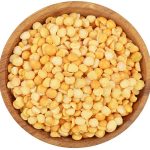
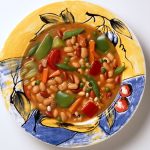
In the quest for more plant-based protein sources, yellow peas have been getting a lot of good press. And the number of packaged foods enhanced with this “pea protein” has tripled in the last few years. But dried split peas, whether yellow or green in color, were an excellent food choice long before they achieved their overnight superstar status. A mere quarter-cup, measured dry (uncooked), will yield 11 to 12 grams of protein, 13 to 16 grams of fiber and just 180 calories. Tip: Read labels on bags of dried peas since these counts vary slightly. Peas are common legumes or “pulses.” While not a complete protein, like meat or chicken, peas have important amino acids including isoleucine, leucine and valine, needed for building muscle. Keep in mind that foods with just the pea protein extract are missing yellow peas’ fiber, B vitamins and a wide variety of essential minerals and phytochemicals. So rather than paying up for products with added pea protein, especially if it’s the only healthy ingredient in the box, consider adding whole split peas to your diet with meals you make at home. Dried peas are perfect for do-ahead meals. Take a few minutes to cook up a batch, and then use them in recipes throughout the week. They form the base of many Indian dishes and hearty soups. They can…  read on >

You’ve made the decision to improve your eating habits, but where should you begin? It can seem overwhelming at first. One way to approach new lifestyle habits is to map out the improvements you’d like to make and tackle them one at a time, over a week or two, before making the next change. Here are three steps to schedule on your calendar: Start by making better food choices at meals. Do you forgo breakfast at home and automatically go to your favorite drive-thru or opt for a donut in the break room at work? Your first change might be to have a healthy whole-grain cereal or a plain yogurt with fruit for your morning meal. Pack it in your tote if you aren’t hungry before you leave the house. Next, upgrade your supermarket choices. Is your cart typically loaded with convenience foods? The next time you shop, buy the fresh foods needed to replace at least one meal a day with a from-scratch recipe. When you need convenience items, think of precut fixings for a vegetable salad and a roasted chicken or cooked shrimp for nutritious proteins. Finally, revamp your cooking style. If your favorite recipes are breaded and fried, or loaded with butter and cheese, cut back on some of these high-calorie techniques. It can be as simple as switching from cream-based sauces…  read on >

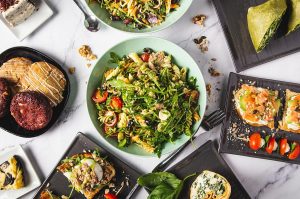
Pile those vegetables and fruits high when you sit down to eat, and your heart will thank you. A diet rich in plant-based foods translated into fewer heart problems in a new study. For the study, the researchers analyzed data collected from more than 10,000 middle-aged U.S. adults who were followed from 1987 through 2016. None had heart disease at the start of that period. The participants’ eating habits were analyzed and their eating patterns were grouped according to the proportion of plant-based foods they ate versus the proportion of animal-based foods. Compared to those who ate mostly animal-based foods, those who ate mostly plant-based foods had a: 16% lower risk of heart attack, stroke, heart failure and other heart problems; a 32% lower risk of death from heart disease; and a 25% lower risk of death from any cause during the study period. The study was published online Aug. 7 in the Journal of the American Heart Association. “While you don’t have to give up foods derived from animals completely, our study does suggest that eating a larger proportion of plant-based foods and a smaller proportion of animal-based foods may help reduce your risk of having a heart attack, stroke or other type of cardiovascular disease,” said researcher Casey Rebholz. She’s an assistant professor of epidemiology at Johns Hopkins Bloomberg School of Public Health,…  read on >