









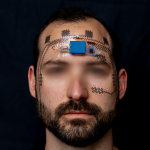
Ever thought so long and hard on a problem that your forehead grew hot, your brain became frazzled and your eyes grew bleary? A new temporary tattoo can help measure that sort of mental strain, researchers report. The wireless forehead electronic tattoo decodes brainwaves to measure mental strain and potential burnout without bulky headgear, researchers reported today in the journal Device. This e-tattoo could help improve safety among folks in jobs that require constant focus, like air traffic controllers or truckers, researchers said. “We’ve long monitored workers’ physical health, tracking injuries and muscle strain,” researcher Luis Sentis, a professor of engineering at the University of Texas at Austin, said in a news release. “Now we have the ability to monitor mental strain, which hasn’t been tracked,” he continued. “This could fundamentally change how organizations ensure the overall well-being of their workforce.” There’s a cognitive “Goldilocks zone” for humans, where they perform best when they’re neither overwhelmed nor bored, researchers said in background notes. “There is an optimal mental workload for optimal performance, which differs from person to person,” senior researcher Nanshu Lu, a professor of engineering at the University of Texas at Austin, said in a news release. The wireless e-tattoo consists of a lightweight battery back and paper-thin sticker-like sensors, researcher said. The sensors feature wavy loops and coils, which allows them to stretch…  read on >  read on >

Belly flab appears to be a stronger warning sign for psoriasis than fat located elsewhere on the body, a new study says. Fat around the abdomen is more strongly linked to psoriasis risk that total body fat, particularly in women. “Our research shows that where fat is stored in the body matters when it comes to psoriasis risk,” lead researcher Dr. Ravi Ramessur, a dermatologist at the St. John’s Institute of Dermatology at King’s College London, said in a news release. Psoriasis is a chronic skin condition in which the body overproduces new skin cells, churning them out in days rather than weeks, according to the American Academy of Dermatology. The overabundant cells pile up, creating thick, scaly patches that itch like the dickens. Many people with psoriasis have excess weight, and it’s well-established that increasing levels of body fat raise a person’s risk of psoriasis, researchers said in background notes. However, it hasn’t been clear if the fat distribution on a person’s body matters when it comes to psoriasis risk, researchers said. For the study, researchers analyzed data from more than 330,000 participants in the U.K. Biobank, a large-scale health research project, including more than 9,000 people with psoriasis. The team examined 25 measures of body fat using traditional methods and advanced imaging techniques to see how each was associated with psoriasis. It turned…  read on >  read on >

Belly flab appears to be a stronger warning sign for psoriasis than fat located elsewhere on the body, a new study says. Fat around the abdomen is more strongly linked to psoriasis risk that total body fat, particularly in women. “Our research shows that where fat is stored in the body matters when it comes to psoriasis risk,” lead researcher Dr. Ravi Ramessur, a dermatologist at the St. John’s Institute of Dermatology at King’s College London, said in a news release. Psoriasis is a chronic skin condition in which the body overproduces new skin cells, churning them out in days rather than weeks, according to the American Academy of Dermatology. The overabundant cells pile up, creating thick, scaly patches that itch like the dickens. Many people with psoriasis have excess weight, and it’s well-established that increasing levels of body fat raise a person’s risk of psoriasis, researchers said in background notes. However, it hasn’t been clear if the fat distribution on a person’s body matters when it comes to psoriasis risk, researchers said. For the study, researchers analyzed data from more than 330,000 participants in the U.K. Biobank, a large-scale health research project, including more than 9,000 people with psoriasis. The team examined 25 measures of body fat using traditional methods and advanced imaging techniques to see how each was associated with psoriasis. It turned…  read on >  read on >

Losing just 6.5% of body weight in midlife may lower later risk of disease and premature death, new research shows. Researchers found that people who lost about 6.5% of their body weight — without using weight loss drugs or surgery — reaped big health benefits later in life, CNN reported. For someone who weighs 180 pounds, that’s just shy of a 12-pound weight loss. “Although correcting midlife overweight without surgical or pharmacological treatment is challenging, our results suggest that it is feasible and may be associated with decreased long-term risk of cardiovascular diseases, other chronic conditions, and mortality outcomes associated with overweight,” the study, led by Dr. Timo Strandberg, a professor of geriatric medicine at the University of Helsinki in Finland, concluded. Published Tuesday in JAMA Network Open, it looked at data from nearly 23,000 adults across three time periods, going back to the 1960s.  Researchers grouped folks based on their body mass index (BMI) at the start and whether they gained, lost or maintained weight. (BMI is an estimate of body fat based on height and weight.) Then, they checked hospital and death records. People who lost weight were less likely to suffer from heart attacks, strokes, cancer, asthma and lung diseases like COPD, the study found. They were also less likely to die from any cause over the next 35 years. It’s worth…  read on >  read on >

Motorcycle helmet laws save lives and prevent many severe injuries, according to a new head-to-head study comparing two states. North Carolina mandates helmets for all motorcyclists, while South Carolina only requires riders younger than 21 to wear them, researchers said. As a result, North Carolina riders had fewer severe injuries and were less likely to require treatment in an intensive care unit after an accident, researchers reported recently in the Journal of the American College of Surgeons. “The two states’ differing laws created a natural experiment,” senior researcher Dr. Britton Christmas, medical director of trauma at Carolinas Medical Center in Charlotte, N.C., said in a news release. “The results are clear: helmets save lives, and universal laws ensure they’re used,” Christmas said. Only 19 states now have universal helmet laws, a sharp decline from 47 states 50 years ago, researchers said in background notes. Efforts from motorcycle groups have driven these repeals, despite trauma surgeons noting the importance of helmets, researchers said. “I’ve testified against repeals in North Carolina because the data doesn’t lie,” Christmas said. “When helmets aren’t required, fewer people wear them, and more die or face life-altering injuries.” For the study, researchers tracked all motorcycle crash patients treated at the Carolinas Medical Center between July 2012 and 2022. Charlotte is near the state line between the Carolinas, and the hospital’s trauma center…  read on >  read on >

Motorcycle helmet laws save lives and prevent many severe injuries, according to a new head-to-head study comparing two states. North Carolina mandates helmets for all motorcyclists, while South Carolina only requires riders younger than 21 to wear them, researchers said. As a result, North Carolina riders had fewer severe injuries and were less likely to require treatment in an intensive care unit after an accident, researchers reported recently in the Journal of the American College of Surgeons. “The two states’ differing laws created a natural experiment,” senior researcher Dr. Britton Christmas, medical director of trauma at Carolinas Medical Center in Charlotte, N.C., said in a news release. “The results are clear: helmets save lives, and universal laws ensure they’re used,” Christmas said. Only 19 states now have universal helmet laws, a sharp decline from 47 states 50 years ago, researchers said in background notes. Efforts from motorcycle groups have driven these repeals, despite trauma surgeons noting the importance of helmets, researchers said. “I’ve testified against repeals in North Carolina because the data doesn’t lie,” Christmas said. “When helmets aren’t required, fewer people wear them, and more die or face life-altering injuries.” For the study, researchers tracked all motorcycle crash patients treated at the Carolinas Medical Center between July 2012 and 2022. Charlotte is near the state line between the Carolinas, and the hospital’s trauma center…  read on >  read on >

Music legend Billy Joel has canceled tour dates through July 2026 after being diagnosed with a brain condition called normal pressure hydrocephalus (NPH). The 76-year-old singer announced Friday that his condition had worsened with recent performances, affecting his hearing, vision and balance, CBS News reported. “I’m sincerely sorry to disappoint our audience, and thank you for understanding,” Joel said in a statement. Doctors have advised him to stop performing for now and begin physical therapy. Joel said he’s hopeful he’ll return to the stage when he feels better. Fans who bought tickets for any upcoming performances will receive automatic refunds.  Joel was originally scheduled to begin a new round of shows in July in Pittsburgh, with other stops across the U.S., Canada, and the U.K. He was set to perform with stars like Stevie Nicks, Rod Stewart and Sting, CBS News said. NPH is a rare condition in which extra fluid builds up in or around the brain, putting pressure on brain tissue. This can lead to “trouble thinking, trouble walking and trouble with urinary incontinence,” CBS News medical correspondent Dr. Jon LaPook said. “Usually, it just comes out of the blue. We really don’t know why,” LaPook said. The condition mostly affects older adults. The Cleveland Clinic says it affects about 0.2% of people in their 70s, and nearly 6% of those over 80.…  read on >  read on >

Music legend Billy Joel has canceled tour dates through July 2026 after being diagnosed with a brain condition called normal pressure hydrocephalus (NPH). The 76-year-old singer announced Friday that his condition had worsened with recent performances, affecting his hearing, vision and balance, CBS News reported. “I’m sincerely sorry to disappoint our audience, and thank you for understanding,” Joel said in a statement. Doctors have advised him to stop performing for now and begin physical therapy. Joel said he’s hopeful he’ll return to the stage when he feels better. Fans who bought tickets for any upcoming performances will receive automatic refunds.  Joel was originally scheduled to begin a new round of shows in July in Pittsburgh, with other stops across the U.S., Canada, and the U.K. He was set to perform with stars like Stevie Nicks, Rod Stewart and Sting, CBS News said. NPH is a rare condition in which extra fluid builds up in or around the brain, putting pressure on brain tissue. This can lead to “trouble thinking, trouble walking and trouble with urinary incontinence,” CBS News medical correspondent Dr. Jon LaPook said. “Usually, it just comes out of the blue. We really don’t know why,” LaPook said. The condition mostly affects older adults. The Cleveland Clinic says it affects about 0.2% of people in their 70s, and nearly 6% of those over 80.…  read on >  read on >

“It’s easier to put your elbow in your ear” is a time-tested way to describe the impossibility of any given task. But the route to easing knee pain might indeed wend through the ear, a new study says. Stimulating the vagus nerve through the ear improved knee pain for some patients, according to early trial results published recently in the journal Osteoarthritis and Cartilage Open. The vagus nerve plays an important role in the parasympathetic nervous system, which controls the body’s ability to rest and digest, researchers said. It is countered by the sympathetic nervous system, which manages the “fight-or-flight” response. “The current evidence suggests that individuals with osteoarthritis knee pain have an imbalance of sympathetic versus parasympathetic activity in the body, which can cause pain,” said lead researcher Kosaku Aoyagi, an assistant professor of physical therapy and movement sciences at the University of Texas at El Paso. “By stimulating the vagus nerve, we hypothesized that our treatment may rectify this imbalance,” Aoyagi said in a news release. For the small-scale trial, researchers recruited 30 patients with knee pain and treated them with a transcutaneous auricular vagus nerve stimulation (tVNS) device for an hour. The device rests on the ear and sends electrical pulses to the branch of the vagus nerve that runs through the ear. It’s already approved by the U.S. Food and Drug…  read on >  read on >

“It’s easier to put your elbow in your ear” is a time-tested way to describe the impossibility of any given task. But the route to easing knee pain might indeed wend through the ear, a new study says. Stimulating the vagus nerve through the ear improved knee pain for some patients, according to early trial results published recently in the journal Osteoarthritis and Cartilage Open. The vagus nerve plays an important role in the parasympathetic nervous system, which controls the body’s ability to rest and digest, researchers said. It is countered by the sympathetic nervous system, which manages the “fight-or-flight” response. “The current evidence suggests that individuals with osteoarthritis knee pain have an imbalance of sympathetic versus parasympathetic activity in the body, which can cause pain,” said lead researcher Kosaku Aoyagi, an assistant professor of physical therapy and movement sciences at the University of Texas at El Paso. “By stimulating the vagus nerve, we hypothesized that our treatment may rectify this imbalance,” Aoyagi said in a news release. For the small-scale trial, researchers recruited 30 patients with knee pain and treated them with a transcutaneous auricular vagus nerve stimulation (tVNS) device for an hour. The device rests on the ear and sends electrical pulses to the branch of the vagus nerve that runs through the ear. It’s already approved by the U.S. Food and Drug…  read on >  read on >