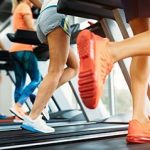








If you’ve ever come home from a brisk walk feeling reinvigorated, you’re not alone. Research shows that this is just one of many benefits of exercising outdoors. Working out in a natural environment can also be more physically challenging, making your body work harder and bringing greater fitness results. This happens when, for instance, you’re walking, hiking or running on natural terrain, which can vary in evenness and require more exertion than on a flat surface, such as a treadmill. According to the American Council on Exercise, other outdoor factors, like wind resistance, actually enable you to burn more calories. If, on the other hand, the wind is at your back, pushing you along a bit, you engage certain muscle fibers needed to develop strength and definition. One study found that people get a variety of psychological boosts from building up a sweat outdoors. Participants were in a better mood and had more energy and less stress afterwards. They simply liked doing the same form of exercise more when they did it outdoors, in nature. There are also benefits from the social interaction of exercising outside with a friend or in a group — the enjoyment you feel makes it more likely that you’ll plan more outdoor workouts. If you have children, exercise with them to show them that fitness activities are fun. Family hikes…  read on >
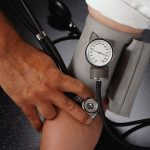
If you have high blood pressure, hitting the gym may be as helpful as taking drugs to lower your numbers, researchers say. There’s “compelling evidence that combining endurance and dynamic resistance training was effective in reducing [blood pressure],” according to the authors of a new report. The British researchers stressed that it’s still too early to recommend that people toss their antihypertensive meds, and exercise instead — there’s not yet been a head-to-head trial of drugs versus exercise for blood pressure. But comparing the numbers from hundreds of blood pressure trials involving either exercise or medication suggests they have the same benefit, said the team led by Huseyin Naci. He’s a health policy researcher at the London School of Economics and Political Science. For now, one U.S. expert said, exercise should be considered an “and” rather than an “or” when it comes to treating high blood pressure. “Exercise is a pillar in the foundation of treatment for hypertension, but for those patients that require drug therapy, exercise is not a replacement for medication,” said Dr. Guy Mintz. He directs cardiovascular health at the Sandra Atlas Bass Heart Hospital in Manhasset, N.Y. The new research was published online Dec. 18 in the British Journal of Sports Medicine. In the study, Naci’s team analyzed data from 197 clinical trials that assessed the effects of structured workouts on…  read on >

Walking is not only a great first exercise, it can also be a forever exercise. Here are some ideas to show you how to take it to the next level. Making walking more of a challenge enables you to burn more calories and raise your working heart rate. You can do this by working out on a treadmill with an incline setting and wearing a weighted vest. You can start with either one to scale up or combine both ideas for a greater challenge. According to the American Council on Exercise, wearing a weighted vest is a great option if you’re relatively new to exercise because it won’t feel as difficult as ramping up your speed, for instance. If you choose a vest that weighs about 15 percent of your bodyweight, you can burn 12 percent more calories when walking at 2.5 miles per hour — an easy pace. You can achieve a slightly higher calorie burn by wearing a vest that’s just 10 percent of your bodyweight if you walk on a treadmill at that speed and at an incline with a 5 or 10 percent grade. To ease into the combined approach, walk for 5 minutes at a flat or 0 grade, then 5 minutes at 5 percent grade, followed by 5 minutes at 10 percent grade. Finish up by going back to…  read on >

Mom was right when she said no swimming for an hour after lunch. Even though it takes energy to work out, it’s important that exercise doesn’t interfere with digestion. Like Goldilocks, you need just the right amount of food. Eat too much and you might feel sluggish rather than energized. Eat too little, and you may not have the stamina to work out effectively. Experts suggest that your pre-workout fueling be personalized to your needs, such as how long your workout will be and whether you’re restricting calories to lose weight. Timing is also very important. If you’ve eaten a full meal, you should wait 3 to 4 hours before exercising. Remember that a healthy meal includes carbs such as whole grains or legumes, non-starchy vegetables, fruit, lean protein like chicken, tofu or fish, and some healthy fat. If you’re trying to lose weight, fill half your plate with vegetables and fruit and a quarter each with lean protein and whole grains or legumes rather than white potatoes or pasta. Fueling Timetable: If eating a large meal: Eat at least 3 to 4 hours before exercise. If eating a small meal: Eat 2 to 3 hours before exercise. If eating a snack: Eat 1 hour before exercise. Of course, it’s not always possible to perfectly time meals to exercise, especially if you train first thing…  read on >

Just as there are diet plateaus, you can hit the wall with exercise, too — no longer seeing results from your efforts and then losing motivation. According to the experts at the American Council on Exercise, a plateau is often a sign that your body has adapted to the specific workout you’re doing and needs a new stimulus to move to the next level. So the first step is to shake up your routine. For instance, if you’ve been steadily walking on a flat treadmill, add an incline. If you walk outdoors, switch to hiking. Also, engage other muscles by alternating with another type of cardio workout than your norm. However, make sure that cardio isn’t the only type of fitness activity you’re doing. If you haven’t stepped up to strength training, it’s time to tackle it. Keep in mind that lifting weights isn’t your only option — you can train with weightless resistance bands or even your own bodyweight (think push-ups and chin-ups). But if it’s your weight training routine that’s stalled, it could be time to switch to heavier weights, more complex lifts or even higher-tension resistance bands. As counterintuitive as it might sound, too much training can backfire and prevent progression. Also, be sure that you’re allowing enough recovery time between strength training sessions. That means at least two days, the time…  read on >

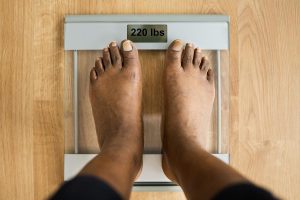
(HealthDay News) — Of course, you should quit smoking. But poor diet, being overweight and not getting enough exercise also are risk factors for developing cancer, the American Cancer Society says. Being overweight or obese raises your risk of cancers of the breast, colon, esophagus, pancreas and kidney, the cancer society warns. When it comes to food, the cancer society suggests eating smaller portions of high-calorie foods; eating fruits, veggies and legumes over other types of food; and avoiding unnecessary sugars and saturated fats. Watching what you eat will help control your weight, as will getting enough exercise. The society cites guidelines recommending at least 150 minutes per week of moderate exercise, or 75 minutes per week of vigorous exercise.

A particular brain wave may help diagnose concussions in high school football players and predict when it’s safe for them to return to play, new research suggests. Delta waves are markers of brain injury and perhaps healing. They tend to decrease with age, but researchers found increased levels of these low-frequency waves in the brains of high school football players after a concussion. Levels declined only after symptoms eased, the researchers observed. “There’s debate right now in the science literature over whether that indicates damage or if it’s a healing response to the damage,” said lead researcher Elizabeth Davenport, an assistant professor of radiology at University of Texas Southwestern O’Donnell Brain Institute in Dallas. “The jury’s out on whether or not it’s healing or just a kind of distress signal.” Concussions are a form of brain injury caused by a blow to the head or violent shaking of the head and body. Davenport suspects delta waves might be a sign of the brain cleaning and repairing itself after such an injury. They might also be a sign of the brain’s connecting cells, axons, being torn apart, she said. These two activities might not, however, be mutually exclusive. As the brain heals, delta waves disappear, Davenport noted. “What we’re really hoping for with this is that it becomes a part of the toolkit that doctors have…  read on >  read on >

The best way to get back to feeling more normal after breast cancer surgery is to get moving, experts say. One surgeon offers some post-surgery suggestions for arm stretches and light aerobic exercise. “People who return to everyday activity sooner after surgery tend to heal better and have fewer complications,” said Dr. Alastair Thompson, section chief of breast surgery at Baylor College of Medicine in Houston. “If you have had surgery to the chest wall, the breast or the armpit, exercising the arm gently is a good way to improve shoulder mobility and reduce swelling,” he said in a college news release. Thompson recommends gentle stretches. Start by touching the top of your head. Reach behind your back. Reach toward the ceiling. Yoga may also provide helpful stretching, but Thompson said it’s important to remember that the area around the surgery site may be less flexible. Aerobic exercise can stimulate the muscles, bones, heart and lungs. “Walking is a good light exercise, and you don’t need anything other than a pair of comfortable shoes to do it,” Thompson noted. “It can be on the treadmill or around your neighborhood, as long as the area is well-lit, and the path is safe under foot.” If you’re a runner, take some time to work back to your usual pace. Give yourself at least five to seven days…  read on >  read on >

The more often you work out, the more effective your COVID-19 vaccination will be, a new study suggests. Fully vaccinated folks who clocked high weekly levels of physical activity were nearly three times less likely to land in the hospital with COVID, compared to those who got the jab but didn’t exercise often, researchers found. “The findings suggest a possible dose response, where high levels of physical activity were associated with higher vaccine effectiveness,” said the researchers led by Dr. Jon Patricios, from Wits Sport and Health (WiSH) and School of Clinical Medicine at the University of the Witwatersrand in Johannesburg-Braamfontein, South Africa. The study was published Oct. 24 in the British Journal of Sports Medicine. “Public health messaging should encourage physical activity as a simple, cost-effective way of enhancing vaccine effectiveness to mitigate the risk of severe COVID-19 illness requiring hospital admission,” the researchers added in a journal news release. For the study, researchers analyzed medical records for nearly 200,000 health care workers belonging to a medical insurance plan with benefits or promotions that required them to wear an activity tracker. Participants were placed in three different physical activity categories — high, medium or low — based on the average weekly amount they worked out during the two years prior to the start of the study. The research team then tracked the outcomes of…  read on >  read on >

If the pandemic has shut down your gym, you can still stay or get fit with a simple home exercise plan, researchers say.

The Canadian study was modeled on a fitness plan known as “5BX,” or Five Basic Exercises, which was originally developed in the 1950s for the Royal Canadian Air Force. The plan doesn’t depend on special equipment and can be adjusted to individual fitness levels.  read on >