










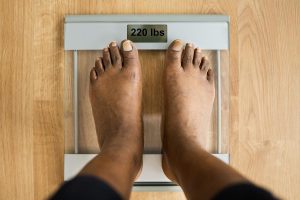
So, after a month of holiday eating, your pants are too tight and you’re desperate to lose the extra weight as quickly as possible, but how much can you lose in a month? Experts say there is no speedy way to shed pounds. How long does it take to lose weight? According to the U.S. Centers for Disease Control and Prevention, people who succeed do it gradually at about 1 to 2 pounds per week, which translates into 4 to 8 pounds a month. Because safely losing weight is such a gradual process, it can take six months or more to lose 30 pounds. But it’s well worth it as you change your lifestyle and look and feel better, experts say. Losing weight permanently is really a matter of changing your lifestyle and diet. The best way is to set safe, achievable goals that you can meet. That all starts with understanding that fad diets or highly restrictive eating plans may prompt fast weight loss, but not permanent weight loss. “Fad diets, by today’s standards, do not work. By work, I mean a sustainable lifestyle that promotes a healthy weight and meets the nutrient needs of the individual,” said Samantha Heller, a nutritionist at NYU Langone Health in New York City. “We need to buckle down and face the fact that a constant diet of…  read on >  read on >

Infants too young to be vaccinated for COVID-19 get some protection from their mothers’ breast milk, researchers say. The new study follows up on findings published in 2021 that showed the breast milk of vaccinated people contained antibodies against the COVID-19 virus. For the study, researchers analyzed infants’ stool. “Our first study showed there were SARS-CoV-2 antibodies in the breast milk, but we couldn’t say if those antibodies were getting through the babies’ gastrointestinal tract and possibly providing protection there,” said senior study author Joseph Larkin III. He is an associate professor in the University of Florida/Institute of Food and Agricultural Sciences, in Gainesville. Larkin and his team used a technique known as a neutralization assay to show that the antibodies found in the infants’ stool offered protection against the virus. “The antibodies run interference and don’t let the virus get to the cells,” Larkin said in a university news release. Even though people think of COVID-19 as a respiratory virus, it can invade the gut. Finding antibodies there is significant, the researchers said. “The antibodies ingested through breast milk may provide a protective coating in the infants’ mouths and gastrointestinal tract,” said first author Dr. Vivian Valcarce Luaces, a postdoctoral fellowship trainee in neonatology. Antibodies found in the blood plasma and milk of the mothers were better able to neutralize the virus, though they…  read on >  read on >
The updated COVID-19 vaccine boosters intended to defend people against emerging Omicron variants don’t appear to provide any better protection than the original shot does, two new studies find. The new mRNA bivalent boosters produced by Moderna and Pfizer only attack the COVID-19 virus about as well as the companies’ first-wave vaccines, according to a blood testing study led by renowned virologist Dr. David Ho, a professor of microbiology and immunology at Columbia University, in New York City. The bivalent shots also failed to promote higher antibody levels or a better immune response than the original COVID-19 vaccines, according to another study led by Dr. Dan Barouch, director of the Center for Virology and Vaccine Research at Beth Israel Deaconess Medical Center, in Boston. Both studies were published online Jan. 11 in the New England Journal of Medicine. Together, the two studies “suggest that with this rapidly evolving virus, vaccines developed for different strains are not going to add a huge difference in terms of protection,” said Dr. Greg Poland, director of the Mayo Clinic’s Vaccine Research Group. It appears that human immune systems “imprint” after exposure to the first mRNA COVID vaccines, experts say. They are primed to respond to aspects of the original COVID-19 strain that are shared by all the variants, rather than the novel mutations sported by newer variants. “It may…  read on >  read on >

Despite routine use of a childhood vaccine, the United States still sees outbreaks of mumps. Now, a new study reinforces the belief that it’s due to waning immunity post-vaccination. Mumps is a viral infection best known for causing puffy cheeks, a swollen jaw, fever and general misery. While it’s usually relatively mild, mumps occasionally causes serious complications like brain inflammation and hearing loss. Because of that, children in the United States are routinely immunized against mumps, using the measles-mumps-rubella (MMR) vaccine. Yet mumps has seen a resurgence in the past two decades. Since 2006, there has been an uptick in annual cases — often among college-age adults who were vaccinated as children, according to the U.S. Centers for Disease Control and Prevention. Similar patterns have been seen in other countries where vaccination rates are high, leading to two theories on why: waning immunity to mumps in the years after vaccination; or the emergence of new mumps strains that evade the vaccine-induced immune response. The new study — published Jan. 9 in the Proceedings of the National Academy of Sciences — supports the waning-immunity view. Using mathematical modeling, researchers found that waning immunity could largely explain the resurgence of mumps in the United States in recent years. They also estimated that about one-third of vaccinated kids start to lose their mumps immunity by age 18. But…  read on >  read on >

Children with autism often have difficulty grasping the emotional cues in other people’s voices, and now researchers may have zeroed in on the reason why. In a study of 43 kids with and without autism, researchers were able to trace such difficulties to a particular brain area — one involved in social communication. Experts said the findings suggest that children with autism are processing the sound of vocal emotions without trouble. The stumbling block can arise in interpreting those sounds. Typically, children learn from an early age to link vocal sounds to particular emotions: They know when their parents are happy or sad, even if they do not understand all the words being said. But many children and adults with autism have difficulty “reading” the emotional cues in other people’s voices, which can make communication much trickier. “Having these skills is crucial in navigating our social world,” said Daniel Abrams, one of the lead researchers on the new study. Oftentimes, he noted, people refrain from plainly saying what they’re feeling, and instead signal it in their tone of voice. “The voice can actually tell you more about emotions than a person’s actual words,” said Abrams, a clinical associate professor of psychiatry at Stanford University School of Medicine. It’s well known that autism, a developmental brain disorder, impairs communication and social skills to varying degrees. But…  read on >  read on >

A leading pediatricians’ group has issued new guidelines on treating obesity in children and teens that, for the first time, call for early, aggressive intervention that can include weight-loss drugs and surgery. “There is no evidence that ‘watchful waiting’ or delayed treatment is appropriate for children with obesity,” Dr. Sandra Hassink, an author of the new American Academy of Pediatrics (AAP) guidelines and vice chair of the Clinical Practice Guideline Subcommittee on Obesity, said in a statement. About 20% of U.S. children now live with obesity, about 15 million children altogether, according to the U.S. Centers for Disease Control and Prevention. The new guidelines recommend against watching and waiting, instead suggesting families of children aged 6 and up should work with their pediatricians on behavior and lifestyle changes. In some cases, families of children aged 2 to 5 should, too, the guidelines recommend. This should include at least 26 hours of counseling over about a year. The new guidelines also suggest that pediatricians should offer obese children aged 12 and up new weight-loss drugs that include Orlistat, Saxenda, Qsymia and Wegovy. Phentermine is approved for kids over 16 years of age, the guidelines said. “The breakthrough that happened in the last few years was people started realizing that there are hormones made in the gut that have multiple roles related to obesity. By targeting these,…  read on >  read on >

Giving up nicotine can be a brutal experience that can include everything from physical symptoms, such as headache and nausea, to mood issues, including irritability, anxiety and depression. Yet, it is still possible to get through nicotine withdrawal symptoms with a good plan and specific tools, according to a smoking cessation expert, who offered some suggestions for coping with nicotine withdrawal symptoms. “Nicotine is highly, highly addictive,” said Emma Brett, a staff scientist at University of Chicago Medicine and a group lead in the Courage to Quit program. “Nicotine affects the brain, blood vessels, metabolism. There are effects all throughout the body.” Quitting requires an adjustment period, she stressed. Most commonly, withdrawal symptoms happen in the first week after quitting, peaking at about day three or four, Brett said. Some may experience nicotine withdrawal symptoms for weeks. Some may have few symptoms at all. Using nicotine replacement aids Nicotine replacement products can be helpful to get someone through those initial days, weeks or months. “We know from the research that when people quit and use something like a patch or lozenge or gum, that can almost double the success rate of a quit attempt,” because you’re still getting some nicotine, just it’s delivered in a safe way versus the combustion of a cigarette, Brett said. She suggested staying on the products until having a high…  read on >  read on >

When it comes to losing weight, certain foods have a reputation for being all-stars, providing for a body’s nutritional needs while helping keep a person fuller for longer. “You’re looking at plant foods,” said Connie Diekman, a nationally known food and nutrition consultant and former president of the Academy of Nutrition and Dietetics. “You’re looking at whole grains, vegetables, fruit, beans, nuts, seeds.” Though certain diets or special eating plans may limit some of these foods, a healthy diet can include all of them, with an eye toward portion size. Here are some foods to eat to lose weight: Whole grains Whole grains haven’t been stripped of nutrients in processing, according to the Harvard T.H. Chan School of Public Health, in Boston. Whole grains can also provide a nice balance between protein and carbohydrates, Diekman said. From a weight-loss perspective, these foods contain fiber. “Fiber fills us up and so therefore that blood sugar curve doesn’t drop as rapidly, so you don’t feel the need to eat as often,” Diekman explained. Choices in this category can range quite a bit. There are lesser-known grains like quinoa, millet or bulgur, along with well-known whole wheat breads and pastas, brown rice and oatmeal. Oatmeal got a shout-out recently from the American Heart Association. “It has many, many good qualities,” said Candida Rebello, director of the nutrition and…  read on >  read on >

Travel can be fun, but taxing. As the pandemic ebbs and people venture back out into the world, an expert from Baylor College of Medicine in Houston offers tips for ensuring a healthier, more peaceful vacation or work trip. “Though frequent travel can boost your mood and positively impact your mental health, keep in mind that it’s a two-way street,” said Dr. Mike Ren, assistant professor of family and community medicine at Baylor. “While traveling, it is important to keep up your physical and mental well-being to maximize the beneficial effects of travel.” Common symptoms of travel fatigue include trouble sleeping, feeling disengaged, having higher stress or anxiety levels, and overindulging in food or alcohol. Someone might need to take a break from traveling to reset, if symptoms are severe. Ren suggests talking to a doctor about whether a pause is needed or if symptoms don’t resolve. “An ounce of prevention is worth a pound of cure. Make sure you are up to date on all your vaccinations, particularly for international travel, and if you are on prescription medications, make sure you have an adequate supply for travel and a few days upon return,” Ren said in a Baylor news release. “Make sure to maintain a good level of hygiene by washing your hands often and take advantage of telehealth visits while traveling if symptoms…  read on >  read on >

You’ve cut back on your eating, started an exercise routine and just can’t seem to lose weight. What’s going on? It could be a number of issues that are causing you to ask yourself, “Why can’t I lose weight?” The good news is that you can work through them. “It’s very complicated, which is what people need to remember. It’s not a simple task to say I’m going to lose weight and it happens,” said Connie Diekman, a nationally known food and nutrition consultant and former president of the Academy of Nutrition and Dietetics. “So, give yourself a break.” When it comes to eating, food choices, portion sizes and intent — whether you’re eating because you’re hungry or in an attempt to fill an emotional need — all play a role, Diekman said. Of course, exercise has its place. Not to be discounted is the significant role that biology and genetics play. “Not everyone can achieve the weight loss they want to achieve. In other words, our bodies sometimes are smarter than we are,” Diekman said. That doesn’t mean that everyone can’t achieve what is a healthy weight for them by understanding what they can control. Typically, weight gain or loss is a calculation of energy intake and expenditure, but being overweight or obese is more complex, with genetics, behavior and environmental factors contributing, according…  read on >  read on >