









Texts deliver rapid-fire messages, but a new study indicates human brains can keep up with the barrage. The brain can detect the basic linguistic structure of a brief sentence in roughly 150 milliseconds — about the speed of a blink of an eye, researchers report. “Our experiments reveal that the brain’s language comprehension system may be able to perceive language similarly to visual scenes, whose essence can be grasped quickly from a single glance,” said lead researcher Liina Pylkkanen, a professor in New York University’s Department of Linguistics and Department of Psychology. In essence, text or images can be taken in and processed much more quickly than anything someone might say to a person, researchers said. “The human brain’s processing capacity for language may be much faster than what we might think,” Pylkkanen said in a university news release. “In the amount of time it takes to hear one syllable, the brain can actually detect the structure of a short sentence.”   The rise of email, followed by texts and social media, has promoted a quick and fragmented consumption of information, researchers said. Short messages are constantly flashing at people through phone notifications and online platforms. “This shift has made it clear that our brains not only have the ability to instinctively process rapid messages, but can also make snap decisions based on them — like…  read on >  read on >

Medication and behavioral therapy are both effective in combatting fatigue caused by multiple sclerosis (MS), either separately or together, a new study finds. MS patients felt significantly less fatigue after they were prescribed modafinil (Provigil), a drug that promotes wakefulness and is used to treat sleepiness, researchers reported recently in The Lancet Neurology journal. Patients also reported less fatigue after they were given cognitive behavioral therapy (CBT), in which they were taught to recognize the factors that make their fatigue symptoms worse or better. Combining the two treatments, drugs and therapy, provided about the same results as either on their own. However, a person’s own sleep habits also played a role in whether one or the other would work better, researchers discovered. “This research offers new evidence to show that both CBT and modafinil are comparably effective for MS fatigue, which could shape treatment approaches to one of the most challenging symptoms experienced by people with multiple sclerosis,” said lead researcher Dr. Tiffany Braley, director of the University of Michigan Health’s Multiple Sclerosis/Neuroimmunology Division. As many as 90% of the nearly 3 million people with MS worldwide experience fatigue, and nearly half describe it as their worst symptom. For this study, researchers randomly assigned nearly 340 patients to either undergo CBT, take modafinil, or use both. More than 60% of participants in each group reported…  read on >  read on >

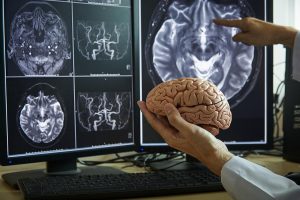
Brain scans can provide early warning of who will develop chronic pain following a whiplash injury, a new study finds. Higher levels of “cross talk” between two specific brain regions within one to three days of the injury increases the risk that pain will last long-term, researchers found. The more the hippocampus (the brain’s memory center) talked to the cortex (involved in long-term memory), the more likely a person was to develop chronic pain, results showed. In addition, the higher a person’s anxiety was immediately after a whiplash accident, the more precisely doctors could predict the chronic pain they would feel a year later. These results highlight the role that memory plays in a person’s pain perception, said lead researcher Paulo Branco, an assistant professor of anesthesiology and pain medicine at Northwestern University’s Feinberg School of Medicine. “While we commonly think of pain as relating only to an injury, it is the brain that actually makes up the pain experience,” Branco said in a Northwestern news release. “The brain makes the decision about whether a movement should be painful or not, and we think this may rely on previous experiences stored in memory.” For the study, researchers gathered data on more than 200 whiplash patients, of whom 177 had MRI scans performed on their brains within three days of their injury. The data was collected…  read on >  read on >

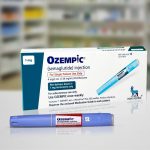
Add Alzheimer’s disease to the list of conditions that might benefit from the revolutionary diabetes drug Ozempic, a new study says. People with type 2 diabetes taking semaglutide appeared to have a significantly lower risk of developing Alzheimer’s compared to patients taking seven other diabetes drugs, researchers reported Oct. 24 in the journal Alzheimer’s & Dementia. The results jibe with other studies that have found semaglutide might protect against dementia, said lead researcher Rong Xu, a biomedical informatics professor with Case Western Reserve School of Medicine, in Cleveland. “This new study provides real-world evidence for its impact on Alzheimer’s disease, even though preclinical research has suggested that semaglutide may protect against neurodegeneration and neuroinflammation,” Xu said in a Case Western news release. Semaglutide is a glucagon-like peptide-1 (GLP-1) drug, and is the active agent in Ozempic and its weight-loss cousin, Wegovy. These medications mimic the GLP-1 hormone, which helps control insulin and blood sugar levels, decreases appetite and slows digestion of food. For the study, researchers analyzed three years of health records for nearly 1 million U.S. patients with type 2 diabetes. They found that patients prescribed semaglutide had a significantly lower risk of Alzheimer’s disease, compared to those taking seven other diabetes meds. However, they warned that more research is needed to confirm this potential benefit. “Our results indicate that further research into semaglutide’s…  read on >  read on >

Expanding access to cutting-edge diabetes and weight-loss drugs like Ozempic and Zepbound could prevent more than 42,000 deaths a year in the United States, a new study claims. Obesity and all its attendant ills — type 2 diabetes, heart disease and cancer among them — have had a dramatic impact on American health, researchers said. More than 40% of U.S. adults are obese, and the research team estimates that about half of all annual deaths in the nation occur among the obese. Helping more people shed their excess weight could save a fair portion of those lives, researchers argue. “Expanding access to these medications is not just a matter of improving treatment options but also a crucial public health intervention,” said senior researcher Alison Galvani, a professor of epidemiology at the Yale School of Public Health. Glucagon-like peptide-1 (GLP-1) drugs mimic the GLP-1 hormone, which helps control insulin and blood sugar levels, decreases appetite and slows digestion of food. However, the drugs are costly — people without insurance face paying more than $1,000 a month to take them. What’s more, people often must have some sort of health problem occurring alongside their obesity to get insurance coverage for GLP-1 drugs. Medicare, for example, doesn’t cover the drugs solely for weight loss, researchers noted. For this study, published recently in the Proceedings of the National Academies…  read on >  read on >

If you’re in your 40s or 50s and have trouble getting and staying asleep, that’s not a good sign for brain health as you age, new research suggests. “Our study, which used brain scans to determine participants’ brain age, suggests that poor sleep is linked to nearly three years of additional brain aging as early as middle age,” said study lead author Clémence Cavaillès, of the University of California, San Francisco (UCSF). The research was funded by the National Institute on Aging and was published Oct. 23 in the journal Neurology. The UCSF team focused on 589 people who averaged about 40 years of age at the beginning of the study. Everyone filled out questionnaires on their sleep patterns at age 40 and then again at about age 45. Questions included, “Do you usually have trouble falling asleep?” “Do you usually wake up several times at night?” and “Do you usually wake up far too early?” Survey replies led the researchers to draw up 6 poor sleep characteristics: short sleep duration bad sleep quality difficulty falling asleep, difficulty staying asleep early morning awakening daytime sleepiness At about age 55, everyone underwent brain scans to gauge how well their brains were aging. After adjusting for potential confounding factors such as age, sex, high blood pressure and diabetes, Cavaillès’ team found that folks with four or more…  read on >  read on >

Maybe you’ve seen a cartoon character shake their head back and forth following a sharp blow — clearing away whatever stars or birds are circling their noggins. Turns out, that same move might help coaches and physical trainers identify a concussion that’s occurred on the field. About 72% of athletes — and 92% of football players — said they’ve quickly shaken their head back and forth following a concussion, researchers report. These SHAAKEs — Spontaneous Headshake After a Kinematic Event — might help identify up to 33% of concussions that might otherwise be missed, researchers argued. “Sports and medical organizations should immediately add SHAAKE to their lists of potential concussion signs,” said researcher Chris Nowinski, co-founder of the Concussion Legacy Foundation. “Coaches, medical professionals and concussion spotters should be trained to recognize when a SHAAKE happens and remove athletes for further assessment,” Nowinski added. “It’s an easy change, with no downside, that could prevent catastrophic outcomes and save careers.” A SHAAKE occurs within seconds or minutes of an impact, researchers said. People shake their heads side to side two to eight times a second, typically for less than two seconds, and they aren’t trying to communicate non-verbally with someone else. Nowinski recognized SHAAKE as a potential concussion sign after Miami Dolphins quarterback Tua Tagovailoa suffered a controversial undiagnosed concussion during a game on Sept. 25,…  read on >  read on >

Women fighting breast cancer can relieve some of their chemotherapy “brain fog” through aerobic exercise, a new clinical trial in Canada suggests. Breast cancer patients on chemo who participated in a regular aerobics class reported that they felt sharper and had better quality of life, researchers found. “Our findings strengthen the case for making exercise assessment, recommendation and referral a routine part of cancer care,” said lead researcher Jennifer Brunet, a professor of human kinetics with the University of Ottawa. “This may help empower women living with and beyond cancer to actively manage both their physical and mental health during and after treatment.” For the study, 57 breast cancer patients in Ottawa and Vancouver were randomly assigned to take either 12 weeks or 24 weeks of aerobic exercise along with their chemotherapy. About half of the women started their aerobics regimen at the same time they initiated chemo, and the other half started after they completed chemo. No significant differences between the two groups were found in objective tests of brain function. However, women who took part in aerobics during chemo reported that they felt like they had a clearer, sharper mind, and that their overall quality of life was better. The new study was published recently in the journal Cancer. The results show that more exercise options need to be made available to women…  read on >  read on >

Smokers find it easier to quit if they’re automatically offered support, even if they didn’t ask for it, a new clinical trial finds. Quit rates were higher among health system patients placed in an “opt-out” program, in which tobacco cessation medications and counseling are automatically prescribed upon learning they smoke, researchers found. It’s called an “opt-out” program because people get the meds and counseling unless they opt out of it. After a month, 22% of people in an opt-out group had quit smoking, compared with only 16% of smokers who had to opt into the cessation program, researchers reported recently in the journal JAMA Network Open. “Health care providers don’t ask patients if they would like to get evidence-based care for other conditions like asthma, high blood pressure or diabetes,” said senior researcher Kimber Richter, a professor of population health with the University of Kansas Cancer Center. “They just identify a health condition and provide the best care possible.” “For no reason, we’ve always treated tobacco dependence differently — we wanted to see what would happen if we proactively treated tobacco dependence,” Richter added in a university news release. For the clinical trial, nearly 750 smokers receiving medical care from the University of Kansas Health System were asked about their desire to quit, and then randomly placed into one of two groups. Those assigned to…  read on >  read on >

Light therapy could be a useful treatment for the most common form of age-related macular degeneration, a new study says. The therapy, called photobiomodulation or “red light” therapy, can reduce the risk of vision loss and slow progression of the “dry” form of macular degeneration, researchers reported recently at the annual meeting of the American Academy of Ophthalmology, in Chicago. “It’s the first and only noninvasive treatment that appears to be helpful in improving vision and decreasing progression of dry AMD,” said lead investigator Dr. David Boyer, with the Retina-Vitreous Associates Medical Group in Los Angeles. About 8 out of 10 people with macular degeneration have the “dry” form of the disease. They slowly lose central vision as the macula — a small but important area in the center of the retina — becomes thinner and accumulates tiny clumps of protein called drusen. There are effective drugs available for people with “wet” AMD, in which leaking blood vessels damage the macula, Boyer said. But people with dry AMD have few options to protect their eyesight, aside from changes to their diet and lifestyle, he said. Photobiomodulation uses different wavelengths of light to improve function in the cells of the retina, keeping them healthier for longer. It’s a technique already used in eye diseases like diabetic retinopathy, researchers said. For this study, researchers recruited 100 patients…  read on >  read on >